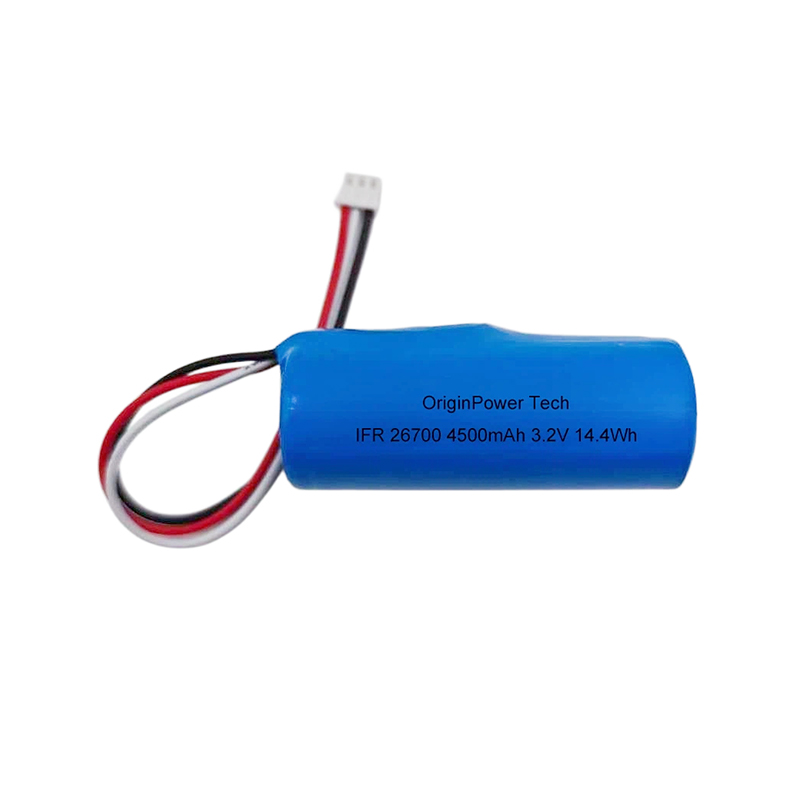
Product Description
Lithium Iron Phosphate (LiFePO₄, abbreviated as LFP) batteries are a type of lithium-ion battery that uses lithium iron phosphate as the cathode material. Distinguished from other lithium-ion battery chemistries (such as lithium cobalt oxide, LiCoO₂), LFP batteries exhibit unique characteristics that make them highly suitable for specific lighting applications. Their core advantages include excellent thermal stability, long cycle life, high safety, and environmental friendliness—traits that directly address the critical requirements of emergency lights, explosion-proof lights, and solar lights.
| Parameter | Specification |
| Cell Type | LiFePO₄ 26700 |
| Nominal Capacity | 4500 mAh |
| Nominal Voltage | 3.2 V |
| Internal Resistance | ≤ 120 mΩ |
| Charge Cut-off Voltage | 3.65 V |
| Discharge Cut-off Voltage | 2.0 V |
| Standard Charge Current | 0.2 C (900 mA) |
| Maximum Charge Current | 0.5 C (2250 mA) |
| Standard Discharge Current | 0.5 C (2250 mA) |
| Max Continuous Discharge Current | 1 C (4500 mA) |
| Charging Temperature | 0 °C – 55 °C |
| Discharging Temperature | –20 °C – 70 °C |
| Cycle Life | ≥ 2 000 cycles @ 80 % capacity retention |
| Weight | ≈ 108 g |
| Dimensions | Ø 26.5 ± 0.2 mm × 71.2 ± 0.5 mm |
| Note | Accept customization |
Emergency lights are often installed in public spaces (hospitals, shopping malls, subway stations) where safety is paramount. LFP batteries have an intrinsic chemical structure that resists thermal runaway—even under extreme conditions (e.g., overcharging, short-circuiting, or physical impact), they rarely catch fire or explode. This eliminates the safety hazards associated with other battery types (e.g., lead-acid batteries, which may leak acid, or LiCoO₂ batteries, which are prone to thermal runaway).
High-quality LiFePO₄ batteries offer a very long cycle life. Well-maintained cells can achieve over 2,000 cycles (to 80% of initial capacity). This translates to over 4 years of service with one cycle per day, making them cost-effective in the long run.
During power outages, emergency lights require consistent brightness to guide evacuation. LFP batteries maintain a flat discharge voltage curve (typically 3.2V per cell) throughout most of their discharge cycle, ensuring the light output remains stable and does not dim prematurely. In contrast, lead-acid batteries experience significant voltage drop as they discharge, leading to reduced brightness in the later stages.
Emergency lights may operate in harsh environments, from cold warehouses (-20°C) to hot industrial facilities (60°C). LFP batteries perform reliably within a temperature range of -20°C to 60°C, whereas lead-acid batteries often lose capacity in low temperatures and degrade quickly in high temperatures.
They are free of heavy metals like cobalt and lead, non-toxic and non-polluting, making them more environmentally friendly. They have no memory effect, allowing convenient recharging at any time without needing a full discharge.
● Do not short-circuit, crush, or puncture the battery.
● Use a compatible charger to avoid overcharge or over-discharge.
● Do not use or store the cell above 70°C or below -20°C.
● Keep away from fire or water.
● For long-term storage, maintain voltage between 3.2V–3.3V.
● Check the cell for damage or swelling before use.